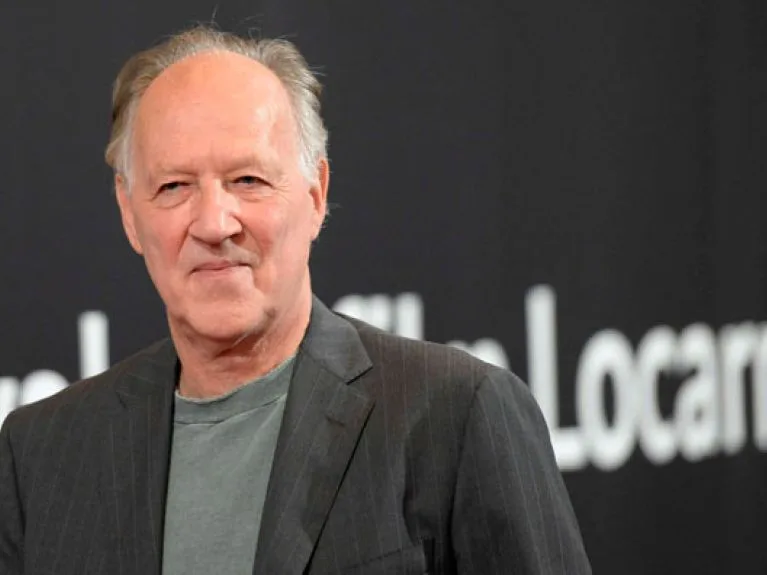
Werner Herzog has spent much of his career filming people and animals that appear to be moving toward something nobody else can entirely understand. Explorers enter impossible landscapes, dreamers pursue objectives that seem increasingly irrational, and nature frequently refuses to provide the comforting explanations humans expect from it. Penguins already occupy a particularly unusual place in Herzog’s filmography. In his 2007 documentary Encounters at the End of the World, Herzog traveled to Antarctica and filmed an Adélie penguin that unexpectedly abandoned the direction of both its colony and feeding grounds and began walking inland toward distant mountains. The sequence later became one of the documentary’s most famous moments, and in 2026 the footage experienced an enormous second life online as the so-called “nihilistic penguin” meme.
Now, in this continuation of that fascination, Herzog is preparing a new documentary built around another remarkable penguin named KAIRA. Researchers first began paying closer attention to the animal after noticing an unusual pattern in its movements. Rather than consistently traveling between feeding areas and the larger group, KAIRA would occasionally begin walking across long stretches of ice with a persistence that seemed completely disproportionate to any obvious destination. The penguin would cross one section of frozen terrain, stop briefly, continue toward another ridge and then keep moving even after the rest of the group had disappeared far behind. When conditions eventually forced KAIRA to change direction, the animal would later begin another long journey, producing what observers described as a seemingly endless cycle of departure, effort and return.
That behavior immediately attracted Herzog’s attention in the project because of the philosophical image it seemed to create. Researchers began jokingly calling KAIRA “The Sisyphean Penguin,” referencing the ancient Greek myth of Sisyphus, condemned to push a stone up a mountain only for it to roll back down every time he approached the top. KAIRA does not push a stone, and there is no evidence that a penguin experiences its journey through anything resembling the philosophical framework humans project onto it. But visually, the comparison is difficult to ignore. A small dark figure moves across an enormous white landscape, climbs toward a distant point, disappears into the ice and eventually begins again.
For Herzog, that ambiguity would be precisely what makes the animal worth filming. His earlier Antarctic documentary became famous in part because he refused to treat wildlife simply as something cute or reassuring. In Encounters at the End of the World, Herzog explicitly questioned why one penguin would leave its normal route and head toward the interior of Antarctica. The real scene showed a lone bird moving toward mountains roughly 70 kilometers away rather than toward food or its colony, creating an image that Herzog used to explore questions about instinct, isolation and behavior that humans may never fully understand.
KAIRA’s story would give Herzog an opportunity to revisit those questions from a completely different angle. The new film would follow the penguin across multiple stages of its journey while researchers attempt to understand whether environmental cues, navigation errors, individual behavioral differences or something else explains its unusual movements. GPS tracking could reconstruct the routes across the ice, while cameras positioned at several locations would capture the scale of the terrain surrounding the animal. But the documentary would deliberately resist turning every movement into a scientific explanation. Herzog’s interest would remain focused on the strange emotional power created when humans watch another living creature continue toward a destination they cannot understand.
The nickname “The Sisyphean Penguin” would gradually become central to that story. A penguin walking across an empty landscape already creates a striking visual contrast, but KAIRA’s repeated journeys turn the image into something that audiences can interpret in completely different ways. Some see determination. Others see futility. Some see independence from the group. Others see an animal simply following signals that humans do not understand. That uncertainty mirrors the reason the original Herzog penguin sequence became such a powerful internet meme almost two decades after it was filmed. The solitary penguin was transformed online into a symbol of alienation, anti-conformity and the decision to continue moving even when the destination appears impossible.
In the documentary, KAIRA would become an even more explicit version of that symbol. One sequence follows the penguin moving for hours across an almost featureless stretch of snow while wind gradually covers the footprints behind it. Another shows KAIRA approaching a difficult section of ice, turning away, circling around and continuing from another direction. The camera remains distant for much of the journey, making the animal appear almost impossibly small compared with the Antarctic landscape. There would be no dramatic music explaining how the audience should feel and no attempt to transform KAIRA into a human character. The fascination would come from simply watching the animal continue.
That visual approach fits Herzog’s longstanding relationship with extreme landscapes. Antarctica in Encounters at the End of the World was never merely scenery. Herzog described the continent through scientists, divers, volcanoes and animals as an environment capable of making ordinary human assumptions feel strangely insignificant. The documentary was less interested in conventional wildlife storytelling than in what living at the edge of the habitable world revealed about curiosity, obsession and existence itself. Herzog has subsequently continued exploring similar ideas in films such as his more recent documentary Ghost Elephants, where the search for elusive animals becomes inseparable from questions about dreams and human desire.
KAIRA would fit almost perfectly into that tradition. The penguin would not need to perform anything extraordinary in the conventional sense. It would simply need to walk. The scale of the landscape would do the rest. Every step would make the destination appear no closer, and every wide shot would reduce the animal to a moving point surrounded by ice. The more KAIRA continues, the less clear it becomes whether the journey should be interpreted as heroic, tragic or completely meaningless.
That is where the Sisyphus comparison becomes especially powerful. In the ancient story, the punishment is not merely that the stone is heavy. It is that the task can never finally be completed. KAIRA’s journeys create a similar visual loop. Walk across the ice. Reach another point. Return. Begin again. Nothing visibly changes, yet the movement continues.
Herzog would reportedly resist explaining whether he personally sees the penguin as tragic. The director has often preferred images that leave space for viewers to confront their own interpretations, and KAIRA’s journey provides exactly that kind of material. Someone exhausted by repetitive work might recognize themselves in the penguin. Someone pursuing an unlikely ambition could interpret the same footage as perseverance. Another viewer might see nothing philosophical whatsoever, just an animal moving through its natural environment while humans attach stories to behavior they barely understand.
Social media would almost certainly do the rest. Clips from the production showing KAIRA walking alone have already begun circulating under captions such as “keep pushing,” “the mountain is never the point,” and simply “KAIRA keeps walking.” The nickname “The Sisyphean Penguin” gives the footage an identity that connects naturally with the philosophical meme culture that formed around Herzog’s earlier penguin scene. Users have begun creating edits that place KAIRA beside representations of endless work, financial markets, personal ambition and the repetitive routines of everyday life.
The irony is that KAIRA would remain completely unaware of any of it. The animal is not performing a metaphor. It does not know Sisyphus, existential philosophy or internet culture. That gap between what the penguin is actually doing and what humans imagine it means could ultimately become the central idea of Herzog’s film.