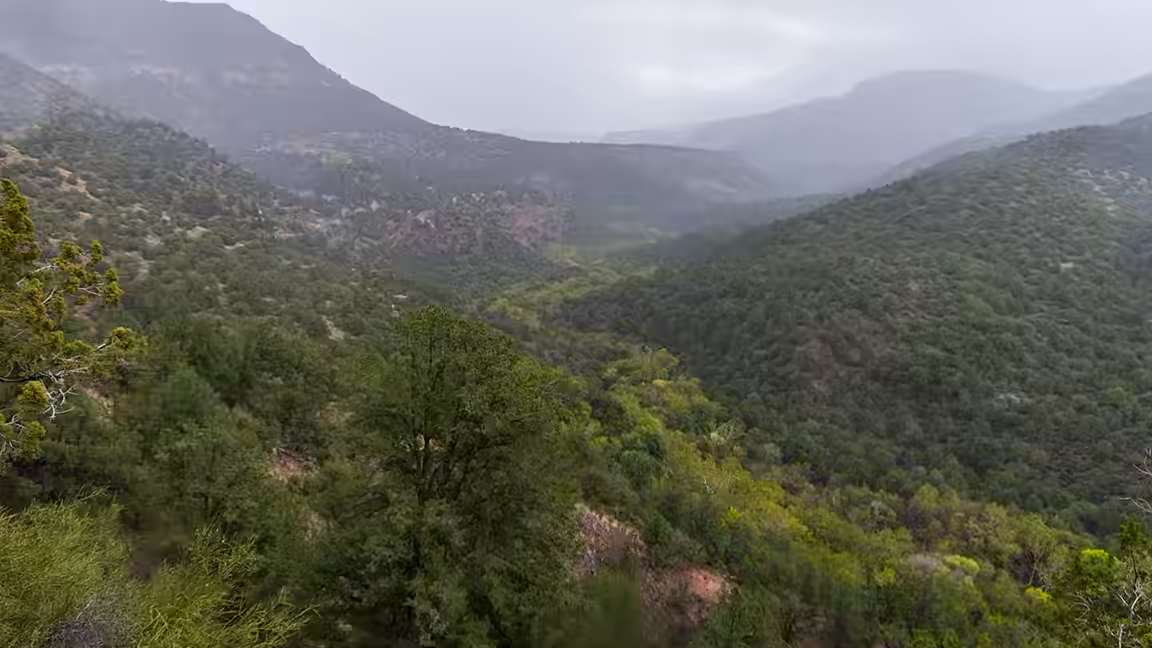
Earthquake hits Granada province and is felt in Madrid after shallow early-morning quake
The event date is August 14, 2026. On that date, a magnitude 4.8 earthquake struck the province of Granada in southern Spain, with shaking felt beyond the epicenter and reported as far away as Madrid.
The supplied evidence is brief, but the core facts are clear. The quake hit at 1.04am on August 15 local time, which in the report corresponds to an early-morning event affecting Granada and neighboring Malaga province. The source also says damage was reported in the Granada area and that the tremor was felt in the capital.
Because only one supplied source is available, the article must stay close to the verified details and avoid overclaiming. What can be said confidently is that the quake was strong enough to be noticed across a wide area and to prompt public attention well beyond the province where it originated. For a mid-range quake, that kind of reach usually reflects both geography and local building response.
The report does not provide a casualty count, and none should be invented. It also does not specify the depth or exact epicenter beyond identifying the Granada area. Those omissions matter because earthquakes can feel very different depending on depth, distance from population centers and local soil conditions. Without those details, the safest report is one that sticks to the observed effects.
What makes the event notable is not magnitude alone but the combination of impact and reach. Granada is a densely populated area with surrounding towns that can feel even moderate earthquakes sharply. When a quake is strong enough to be noticed in Madrid, it is usually because residents over a broad region experienced movement, even if the physical damage remained limited.
The source also shows how quickly local and national coverage can diverge. A regional quake is often first described by where it was felt rather than by technical seismology. That is why the report leads with Granada and Malaga, then notes Madrid. For readers, that is the practical information: where it happened, how strong it was and how widely it was felt.
There is no indication in the supplied evidence that this was a major destructive disaster, and no follow-up claims about emergency response or transport disruption are supported. The article should therefore avoid speculation. Instead, it can say that the quake added another reminder that southern Spain remains seismically active and that even a sub-5.0 event can be widely felt.
The key takeaway is simple: a 4.8 magnitude quake struck near Granada, was felt in multiple provinces and reached Madrid, making it a notable regional seismic event even if the public record in the supplied source remains limited.
The limited source material means the safest interpretation is also the most useful one: this was a widely felt regional quake, not yet a fully documented disaster story. That may sound restrained, but it reflects how earthquake reporting often works in the first hours, when the most reliable public facts are the ones about what people felt and where, not the ones about damage that may take time to assess.